
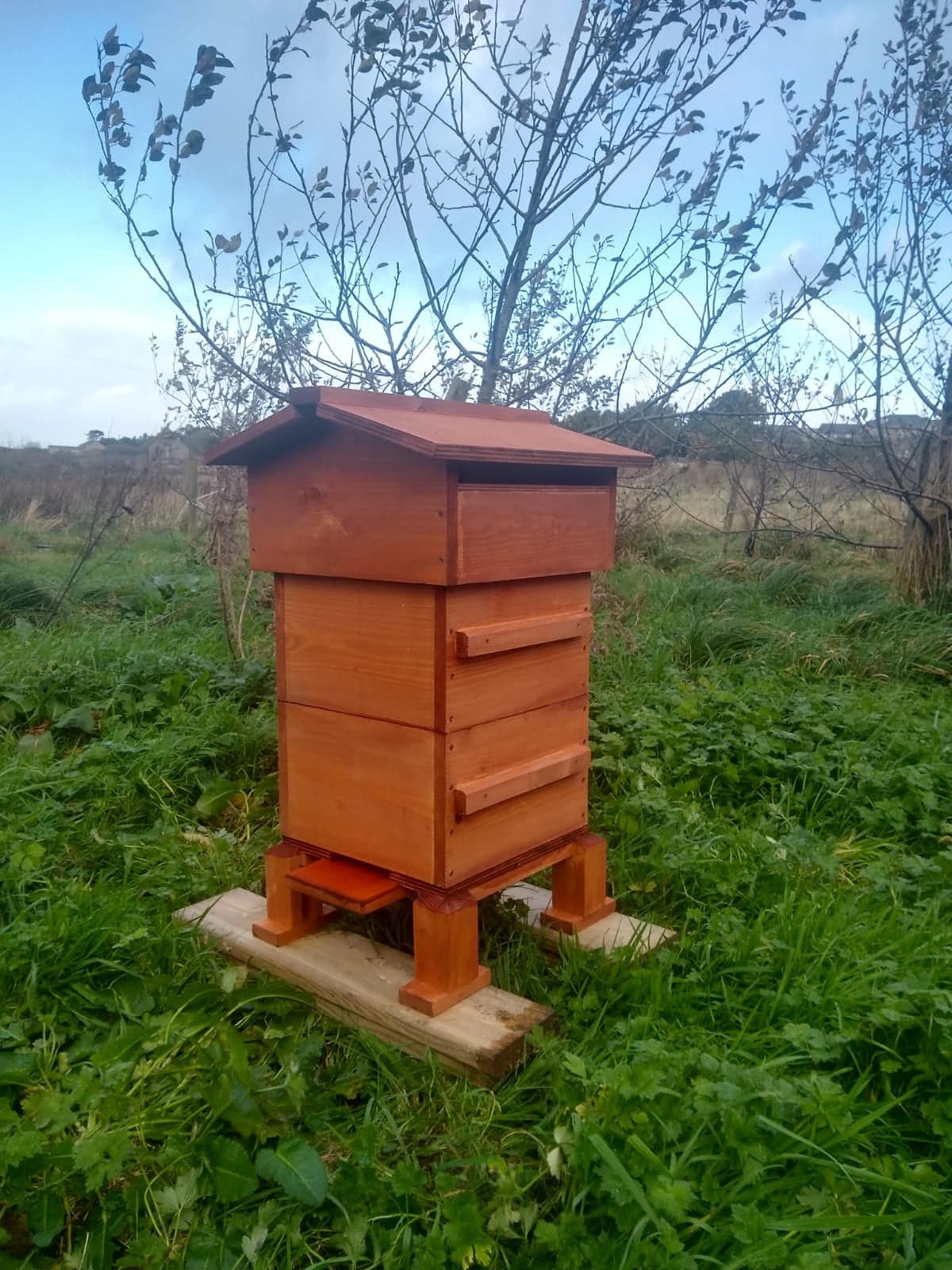
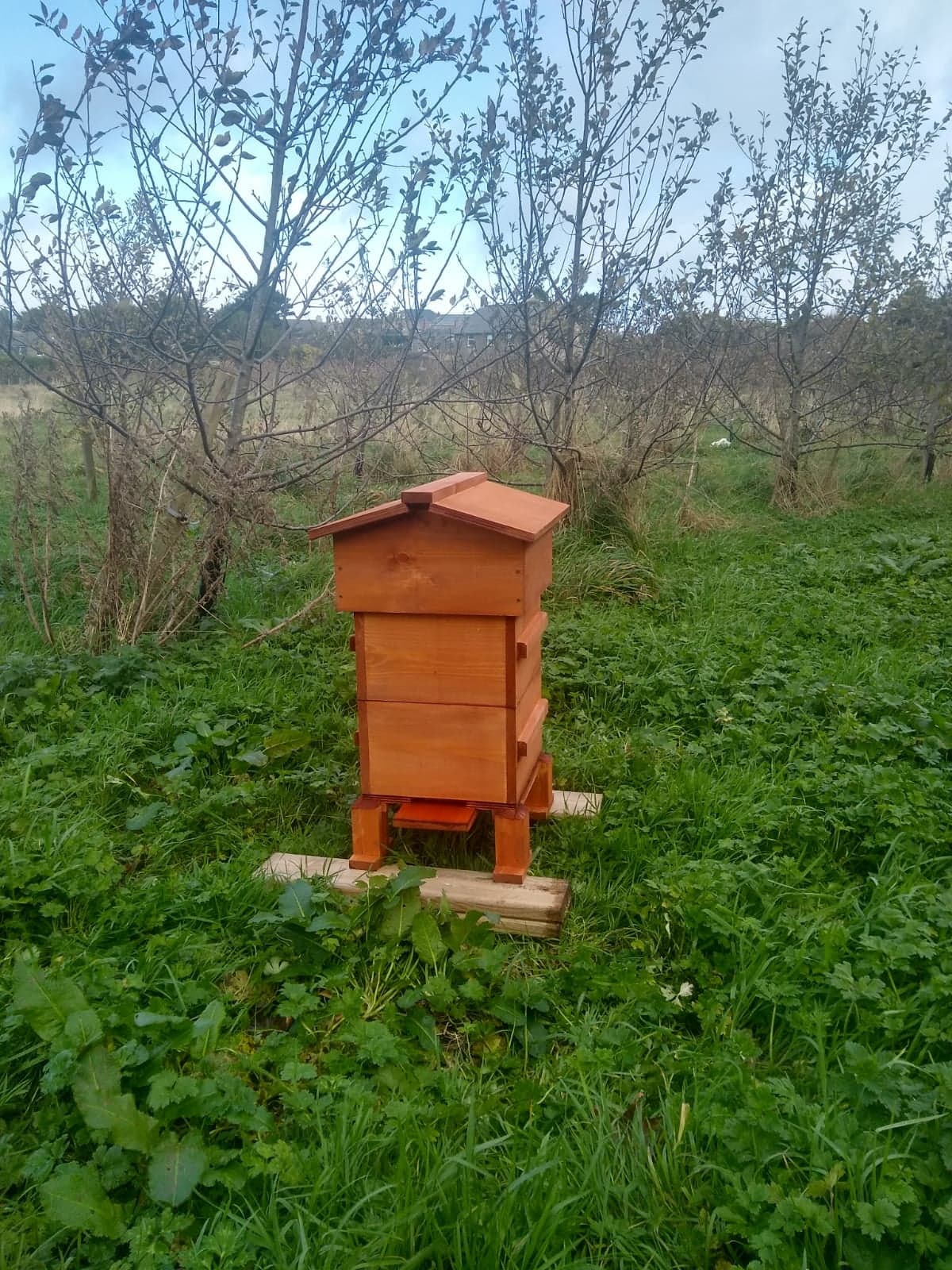
Interested in providing a home for some honey bees? We highly recommend getting a Warre beehive, especially if you keen on very simple, hands off approach to beekeeping. Our Warre beehives are handmade here in our workshop in Halestown, St Ives, Cornwall, using sustainable pine wood. We are providing homes for 5 swarms of bees in St Ives Community orchard and they are very happy bees.
Cost: £250.
Collection from St Ives, Cornwall or Courier £45
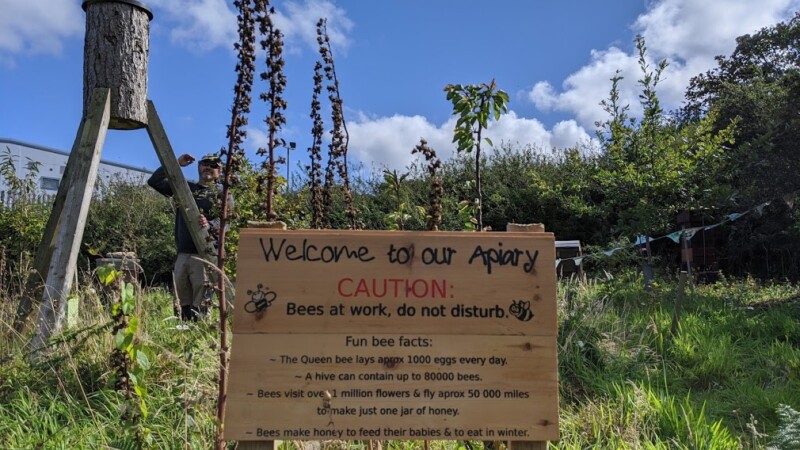
Opportunity to come have a look at our apiary and chat about how to look after the bees.
SIMPLE, NATURAL BEEKEEPING
Warre hives are designed to require minimal to no maintenance. There is no need to frequently inspect the colony, purchase an expensive honey extractor, use foundation and clean the comb out to re-use. It is a low-cost, low-maintenance hive design which simply involves adding extra boxes to the bottom of the stack (called nadiring). The bees move the excess honey stores to the top of the hive and so once the bees have stored way more than they need for their own consumption (we think 3 boxes full is the ideal) then you can remove the top box full of honey and add another box below.
We follow the principles of the natural beekeeping which means that these bees are mostly left to live as they would in the wild. Honey is only taken when there is more than enough for them to survive on through the winter, so no sugar water is needed to be given to them and there is minimal interference of the hives. Most commercial beehives have frames with the foundation comb already there that is used time and time again. Some people believe that this is better as it makes less work for the bees as they don’t have to rebuild the comb after the honey has been taken. However it’s possible that the old comb becomes laden with environmental and agricultural toxins and that this unnatural foundation could lead to a lower immune system in the bees so they become more susceptible to disease. We don’t do any of the conventional beekeeping practices like using queen excluders, replacing old queens with new and treating them with chemicals to stop disease.
MORE ABOUT THE WARRE HIVE
A Warre hive is a vertical top bar hive that uses bars instead of frames, usually with a wooden wedge or guide on the bars from which the bees build their own comb, just like they do in nature. The Warre (pronounced: WAR-ray) hive is named after its inventor, French monk Abbé Émile Warré. He studied hundreds of different hive styles and settled on this one as the most ideal for bees and beekeepers. His design focused on simplicity, ease of management, and mimicry of honeybees’ ideal natural environment.
HISTORY OF WARRE HIVES
Abbe Emile Warre developed the Warre hive over 50 years of research, culminating in what he liked to call “The People’s Hive” in the early 1950s. He studied over 300 hive designs, ranging from straw skeps to the modern Langstroth hive, analyzing their ease of use and suitability for honey bees. He focused on simplicity, ease of management, and natural qualities including the building of natural comb (rather than pressed foundation) and the retention of nest scent and heat.
He frowned upon the invasive, tedious micromanagement of individual frames and combs as practiced by most beekeepers in his day. He found it optimal for bees and keeper that to manipulate the hive box only a couple times a year, rather than comb by comb. This is key to the beekeeping philosophy that corresponds with Warre hives, and it is a tremendous shift away from the common practices used today. Less bothering of bees means more productivity and less disturbance to the colony.
Each year prior to winter the bees move the excess honey stores to the top of the hive, so Warre would typically add a couple empty boxes to the bottom of the hive in the spring and remove the top boxes from the hive (full of honey) in the fall.